Born from an act of cutting apart and reassembling, Permanent Marker asks what might explain the more troubling parts of human nature—and whether what ails us can be identified, mapped, or even repaired.
acrylic monoprints and image transfers on paper and tissue, chalk pastel, graphite, found text, thread on cradled board
16″ x 33.25″ x .88″
2026
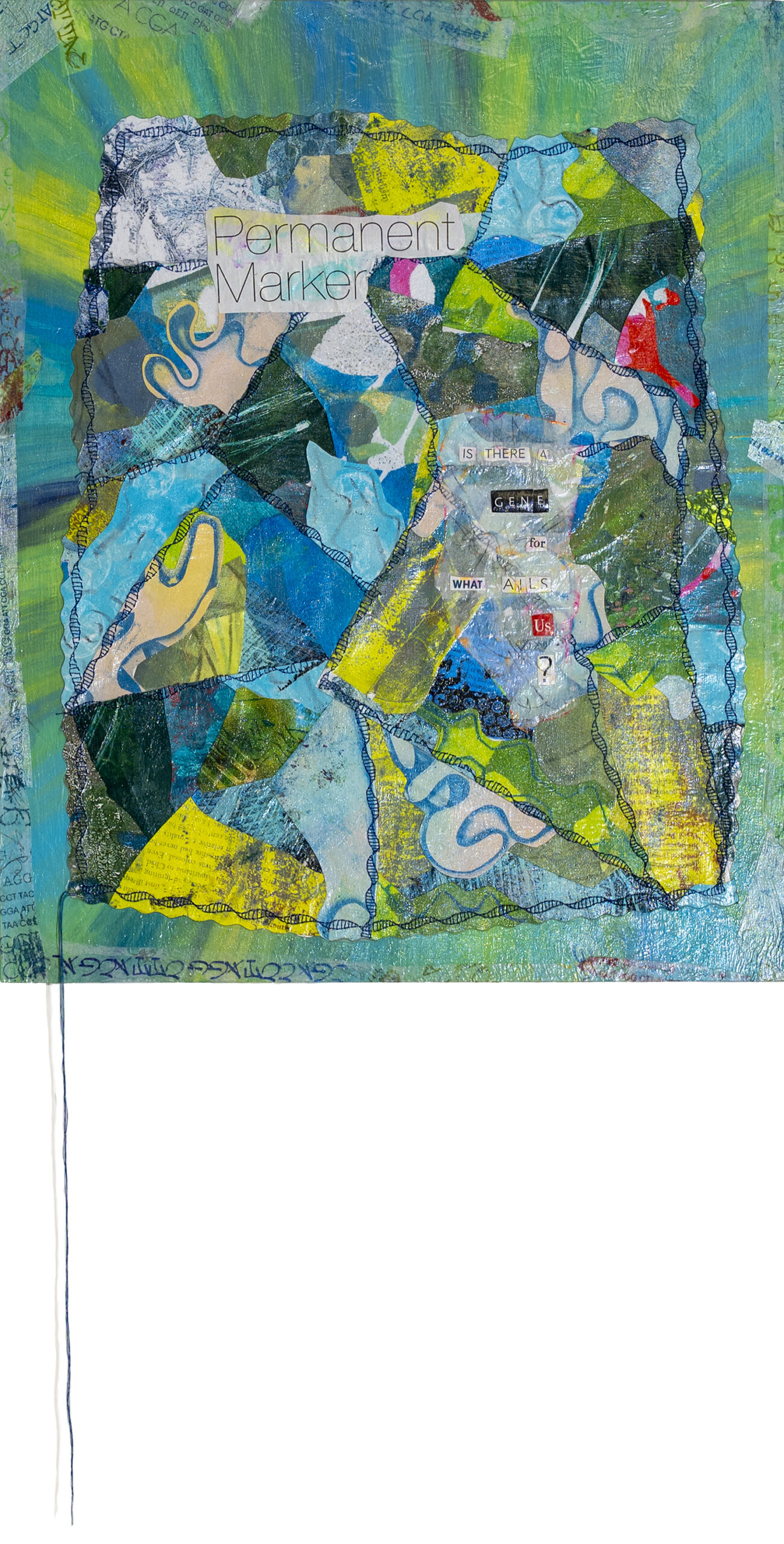
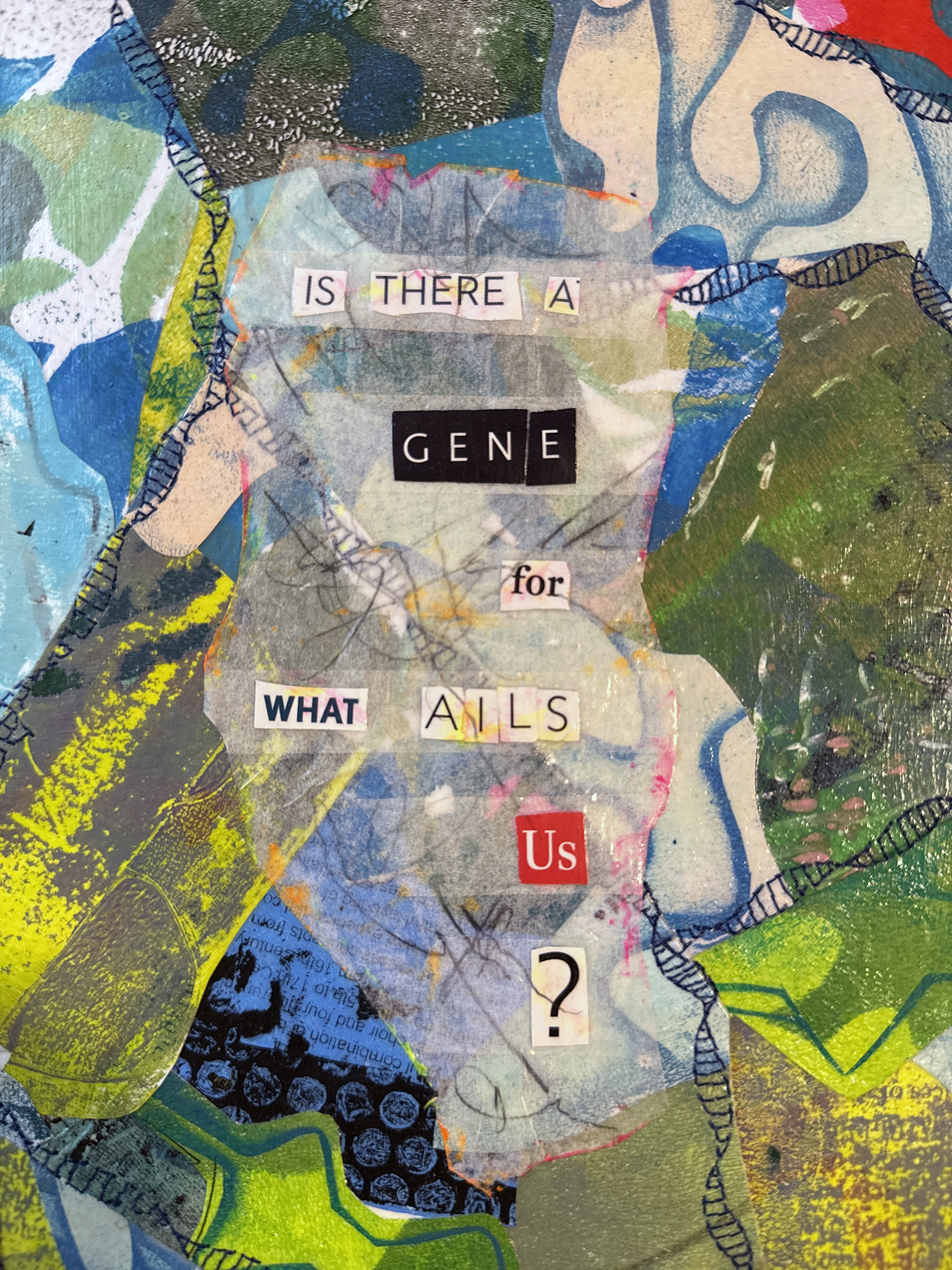
Permanent Marker began without a plan. While demonstrating my collage process, I glued together fragments of acrylic monoprints, then cut the emerging composition apart and began reassembling it. Rifling through found text, I came across the words “Permanent Marker.” The phrase became both title and provocation: What marks us permanently? What is written into us, and what can be altered, repaired, or remade?
Those questions took on greater urgency against a world that can feel increasingly unstable, anxious, and inexplicable. Faced with our capacity for fear, greed, cruelty, and chaos, it is tempting to ask whether there is something fundamentally wrong with us—something encoded deeply enough to identify, map, perhaps even fix. The found text evolved into the question at the center of the work: Is there a gene for what ails us?
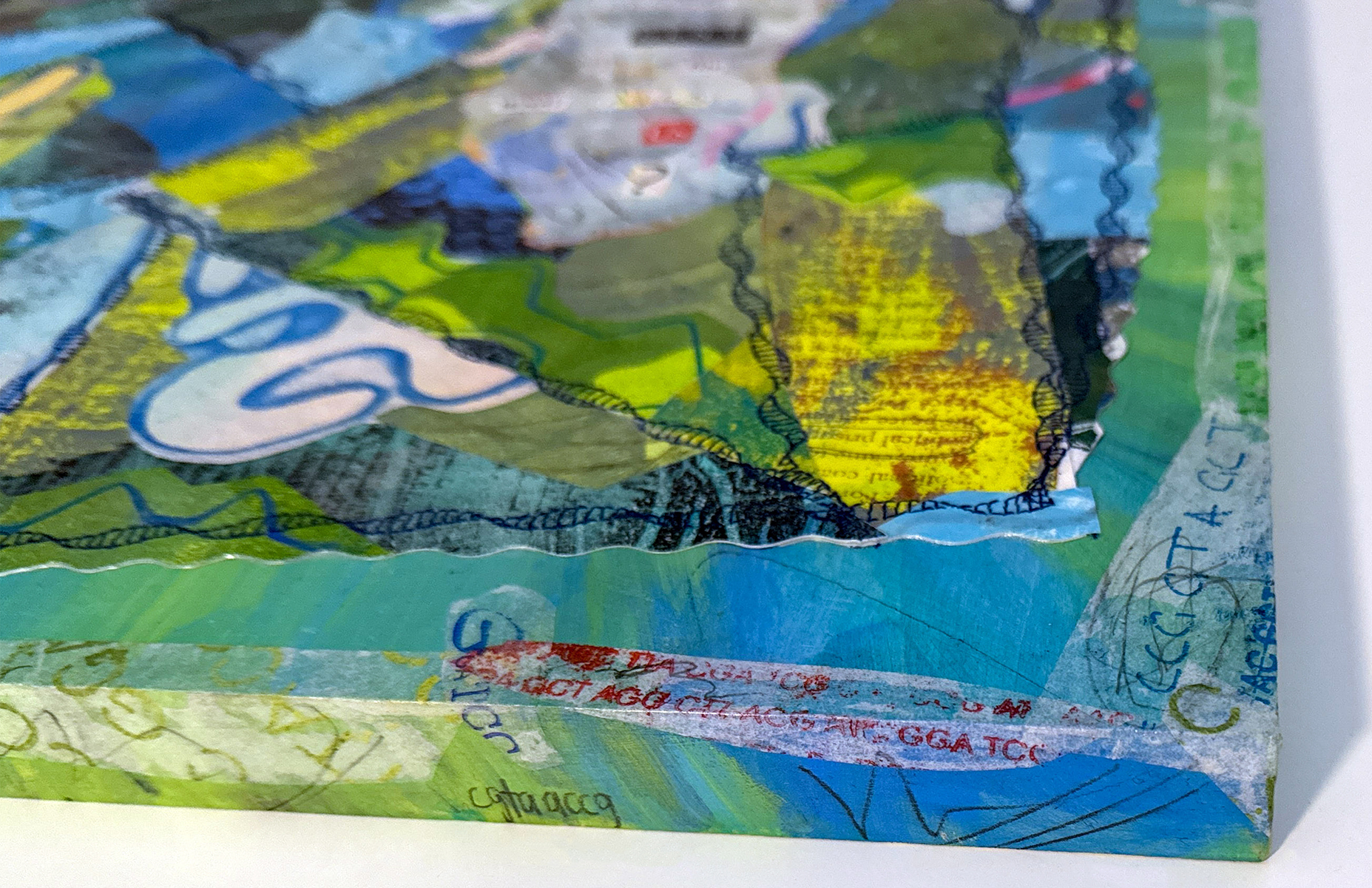
As I worked, the materials began to embody that inquiry. Cut fragments were stitched back together; their boundaries were traced by forms suggesting a double helix. Genetic code migrated to the edges. The composition itself began to resemble a map—territories divided and rejoined, pathways traced, boundaries crossed. Loose threads escape the confines of the board.
The biological language offers no diagnosis. Instead, it becomes a way of asking a larger and less answerable question: how much of what we are is inherent, and how much have we made—and continue to make—of ourselves?