It has never been easy to be a woman in the world. In a moment when hard-won progress is being clawed back, this work brings together a small but resonant group of women who have fought—loudly or quietly—until blue in the face for equality and dignity. Layered over text from Deborah Tannen’s You Just Don’t Understand: Women and Men in Conversation, the piece reflects how women’s voices continue to be misheard, dismissed, and contested.
acrylic, graphite, pen, art, science, memory, hope, despair, joy, activism, feminist rage, paper, Deborah Tannen’s You Just Don’t Understand: Women and Men in Conversation on cradled gesso board
30″ x 40″ x 2″
2025
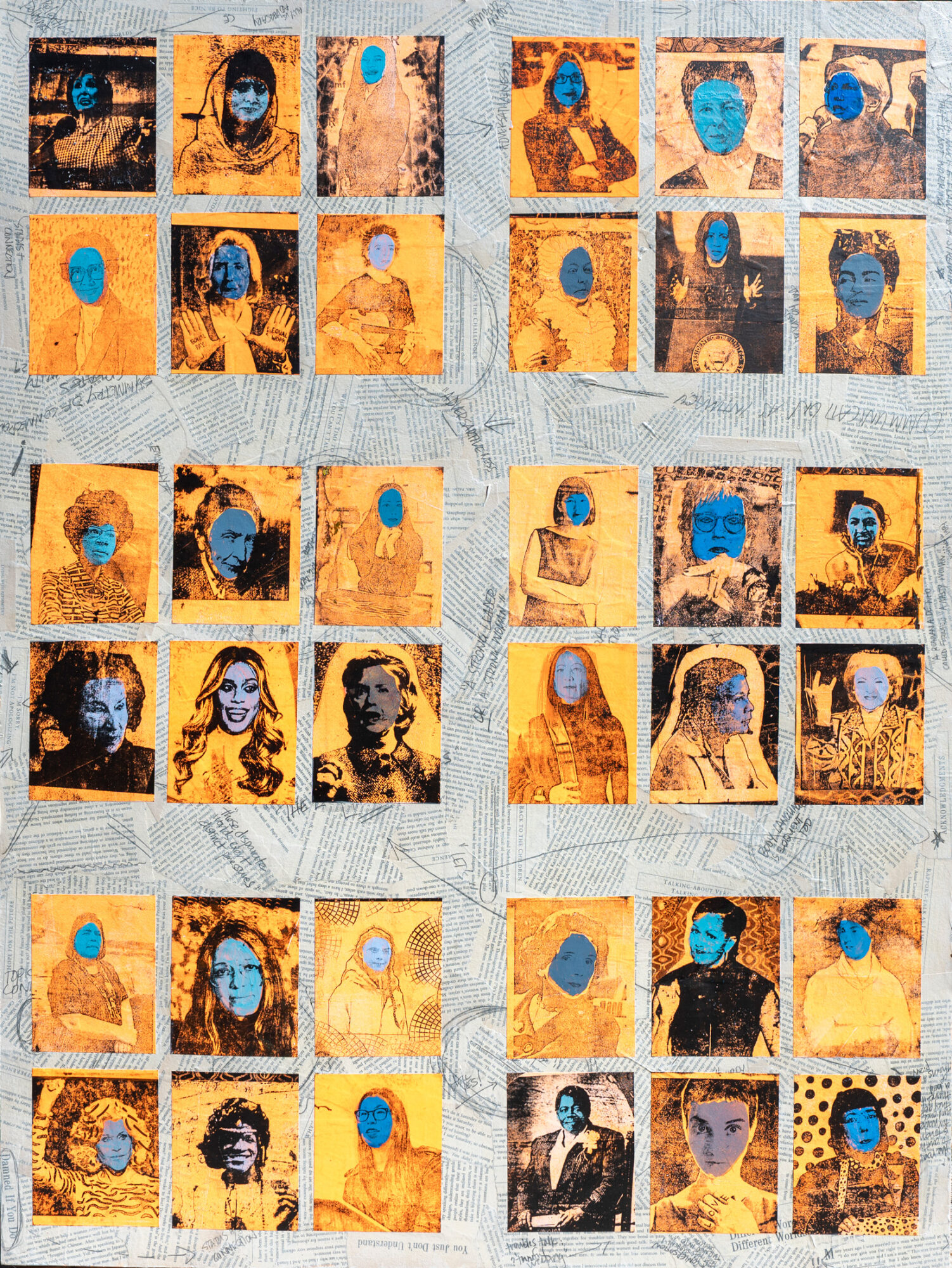


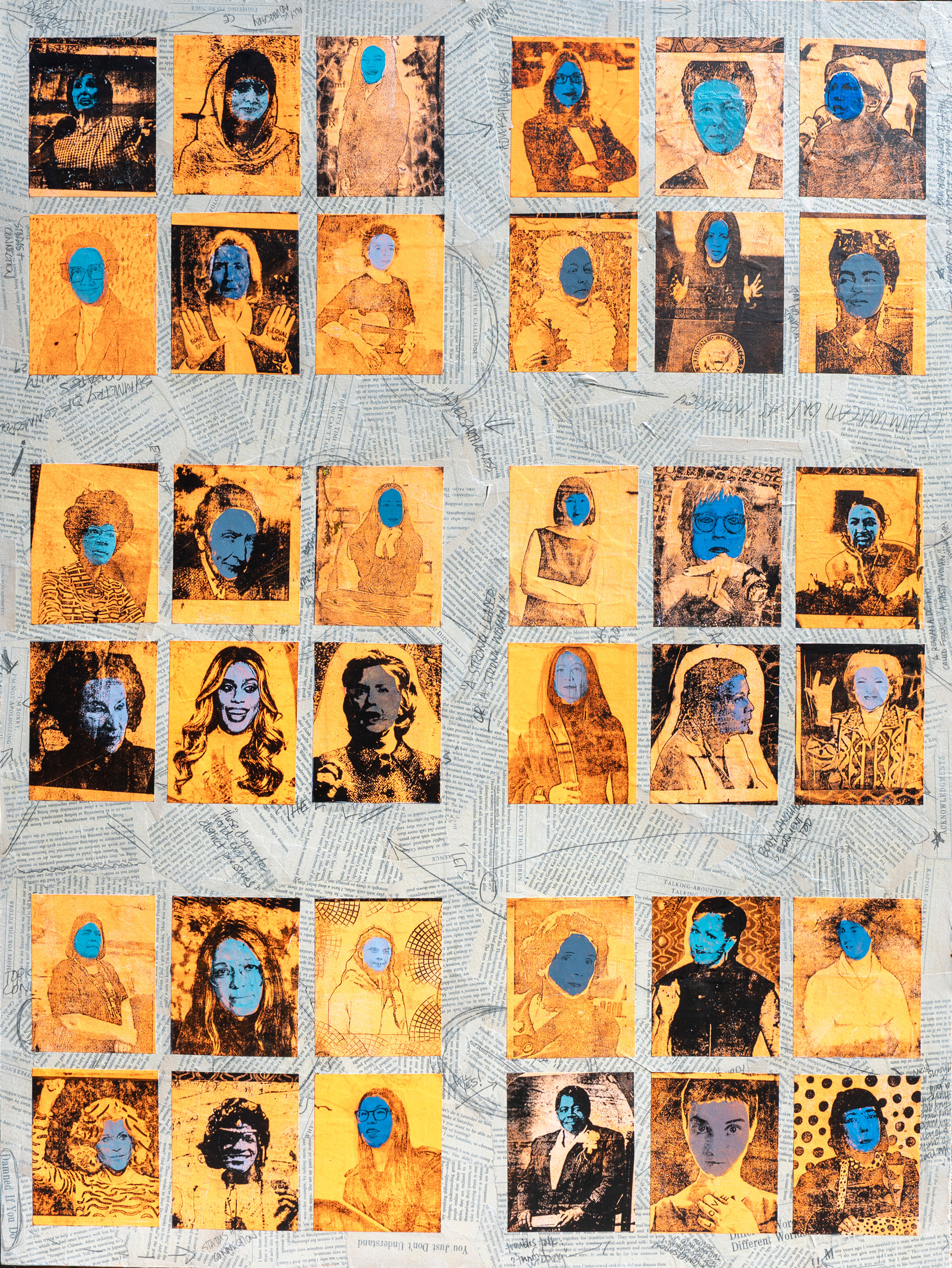
It has never been easy to be a woman in the world. And now, in a moment when hard-won progress is being clawed back, women’s voices—our experiences, our expertise, our very humanity—are once again being ignored, dismissed, and derided.
The faces shown here form a sisterhood, standing in solidarity with women throughout time who have fought—loudly or quietly, publicly or invisibly—until blue in the face. For equality. For dignity. For the right simply to exist on our own terms. This is not an exhaustive roll call—so many other vital voices remain outside the frame. Instead, this is a sampling, a collage of resonance, chosen to suggest the breadth of resistance and to honor a lineage far larger than any one artwork can hold.
The composition references the “six-pack” suspect lineup used in criminal identification—a visual metaphor for how women’s speech and presence have long been treated as suspect, disruptive, or out of order. Here, instead of mugshots, we see portraits of courage, resilience, and refusal.
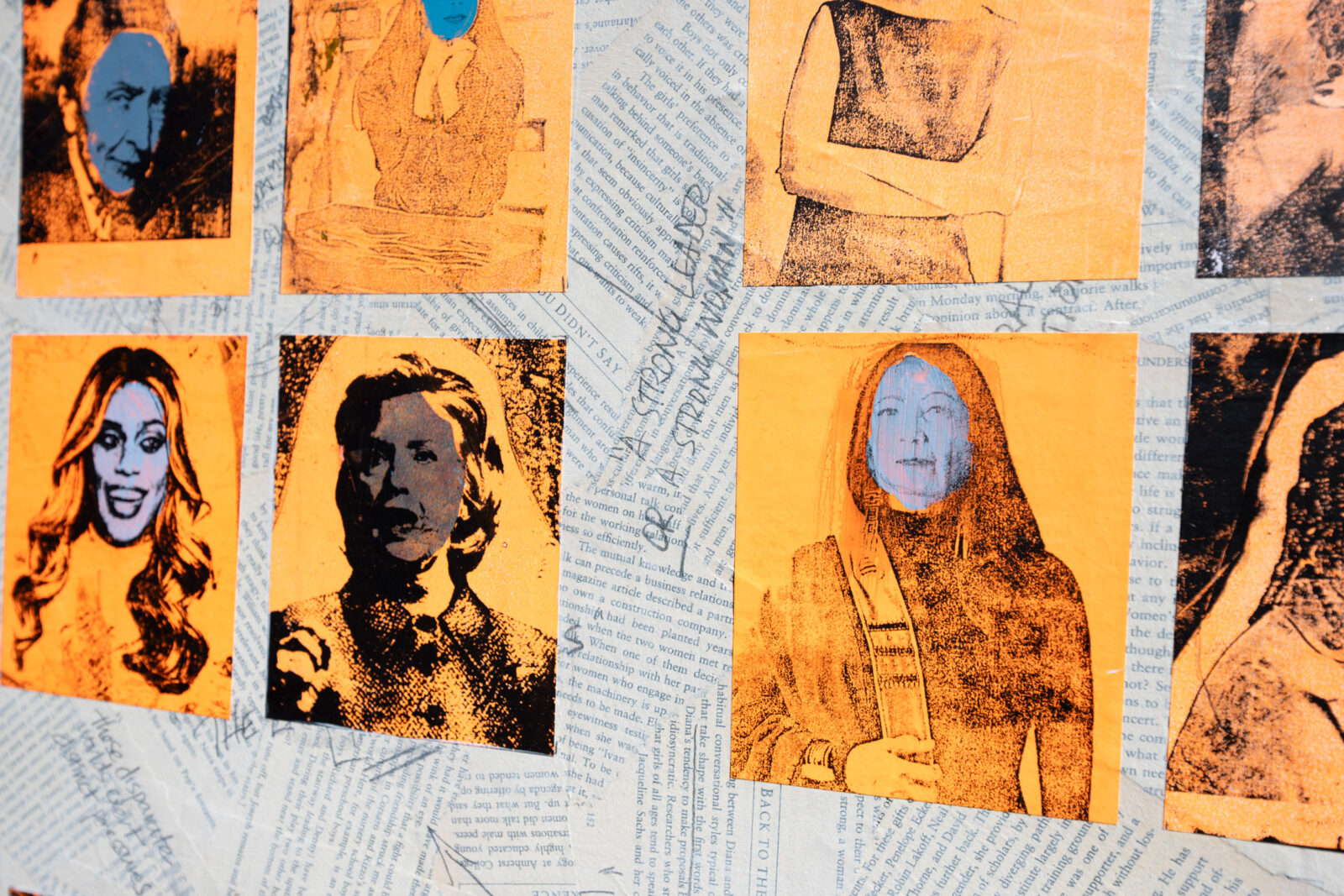
The collage is built on a ground of excerpted text from Deborah Tannen’s You Just Don’t Understand, a book I first encountered in the early 1990s. Her research into gendered patterns of communication helped me find language for what I had long felt but could not yet clearly articulate—how women’s voices are often misheard, devalued, or pathologized, not only in public discourse but in everyday life. More than thirty years later, her insights still resonate.
The layered fragments of text beneath these faces signal both the persistence of this struggle and the transformative power of naming it. The “blue” here is not only exhaustion—it is also insistence, embodiment, breath. To turn blue in the face is to keep speaking, even when it costs something.
Continuing the Conversation
Blue in the Face has developed into an ongoing series, using its original visual language to consider particular histories and arenas in which women have fought to be heard, recognized, and allowed to participate. Each iteration brings together a new group of women, layering their images over texts specific to that struggle and extending the conversation across histories, experiences, and forms of resistance.
Blue in the Face: Fighting for a Voice (2026)
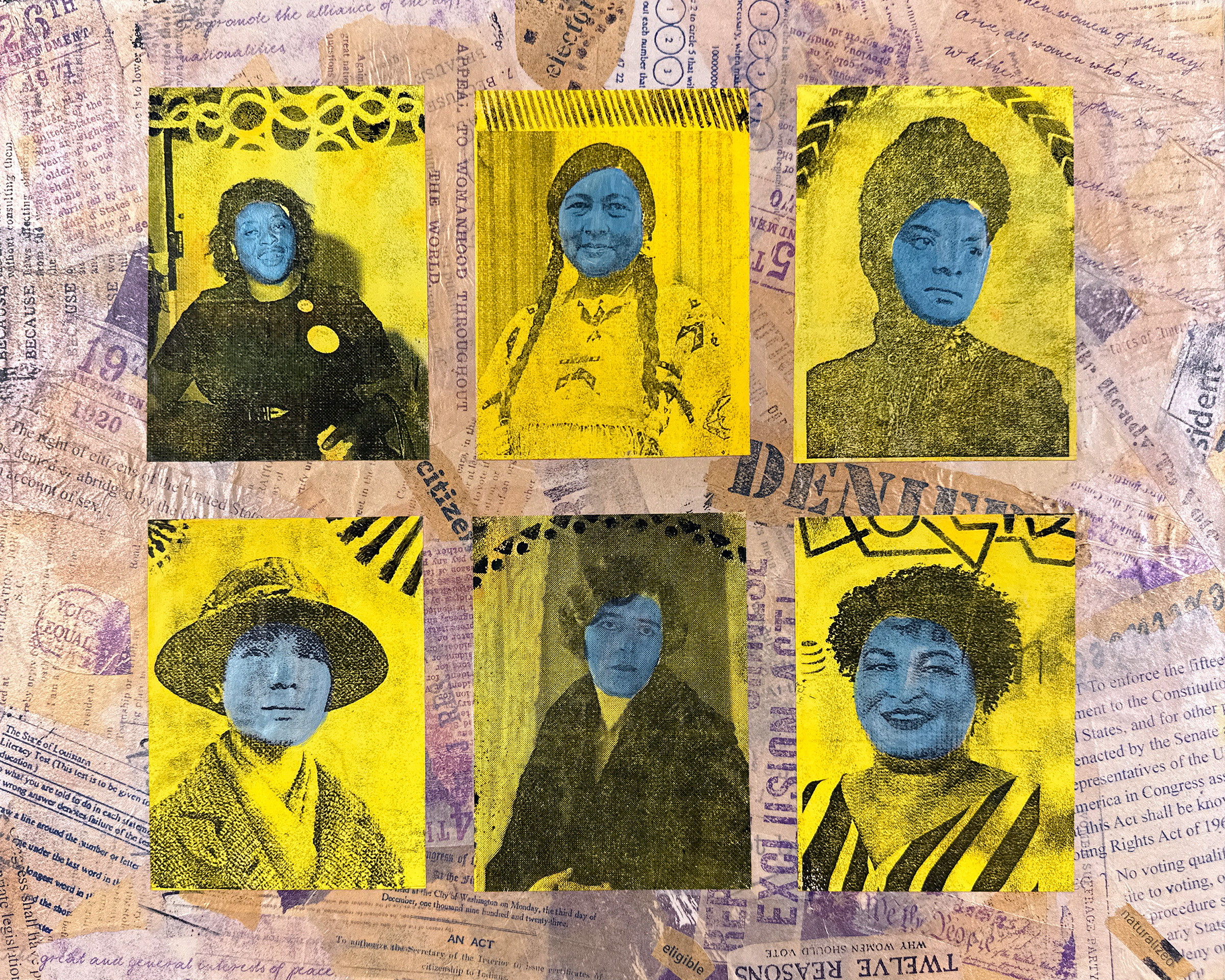
Blue in the Face: Fighting for a Voice brings together six women whose activism expanded the meaning of citizenship and challenged who is permitted to participate fully in American democracy. Rather than presenting suffrage as a single historical victory, the work traces an ongoing struggle across race, culture, and generations, acknowledging that access to the ballot has never been equally shared. Constitutional amendments and landmark legislation form the collaged background, situating these women within the legal structures they challenged, reshaped, and continue to defend. Layered acrylic monoprints, transferred imagery, and text reflect the accumulation of history, while the title suggests the persistence required to claim a public voice—to keep speaking, even when change comes slowly.
acrylic, paper, courage, citizenship, voice, resistance, persistence, history, memory, the Constitution, legislation, female hysteria, poetry, testimony, hope, on cradled board
16″ x 20″ x .75″
2026
Blue in the Face: Working for the Workers (2026)
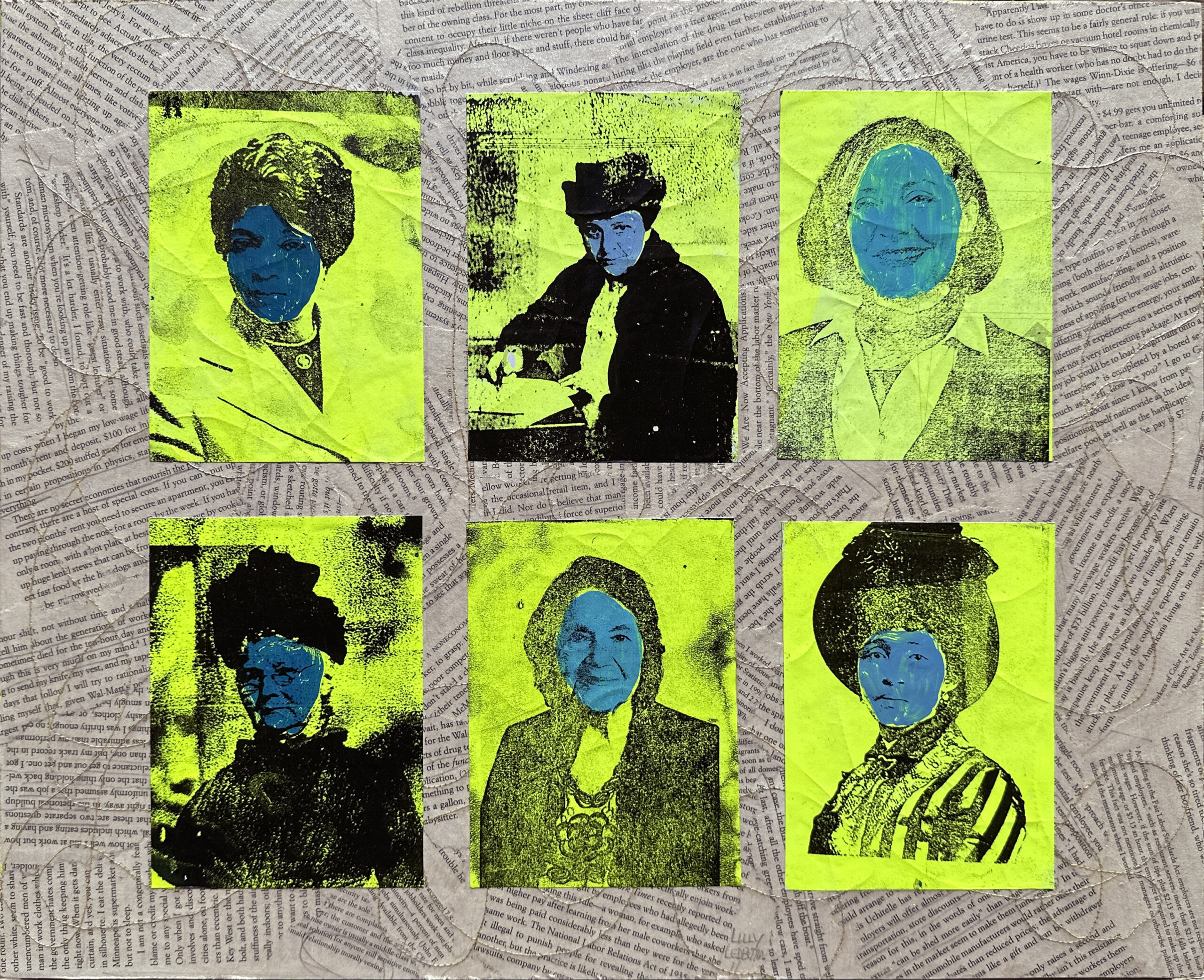
Blue in the Face: Working for the Workers honors women whose activism reshaped the conditions of labor while acknowledging the countless others whose efforts remain outside the frame. Referencing the “six-pack” police lineup, the composition transforms an image of suspicion into one of solidarity, endurance, and collective action. The collaged background incorporates text from Barbara Ehrenreich’s Nickel and Dimed, grounding the work in the realities of low-wage labor and the persistent gap between work and survival. The layered acrylic monoprints, transferred imagery, and text evoke the collective nature of this history, while the title suggests both exhaustion and persistence—to be “blue in the face” is to keep speaking, organizing, and demanding dignity long after others would prefer silence.
acrylic, graphite, stitching, advocacy, tenacity, memory, hope, despair, joy, activism, feminist rage, paper, Barbara Ehrenreich’s Nickel and Dimed: On (Not) Getting By in America on cradled board
16″ x 20″ x .75″
2026